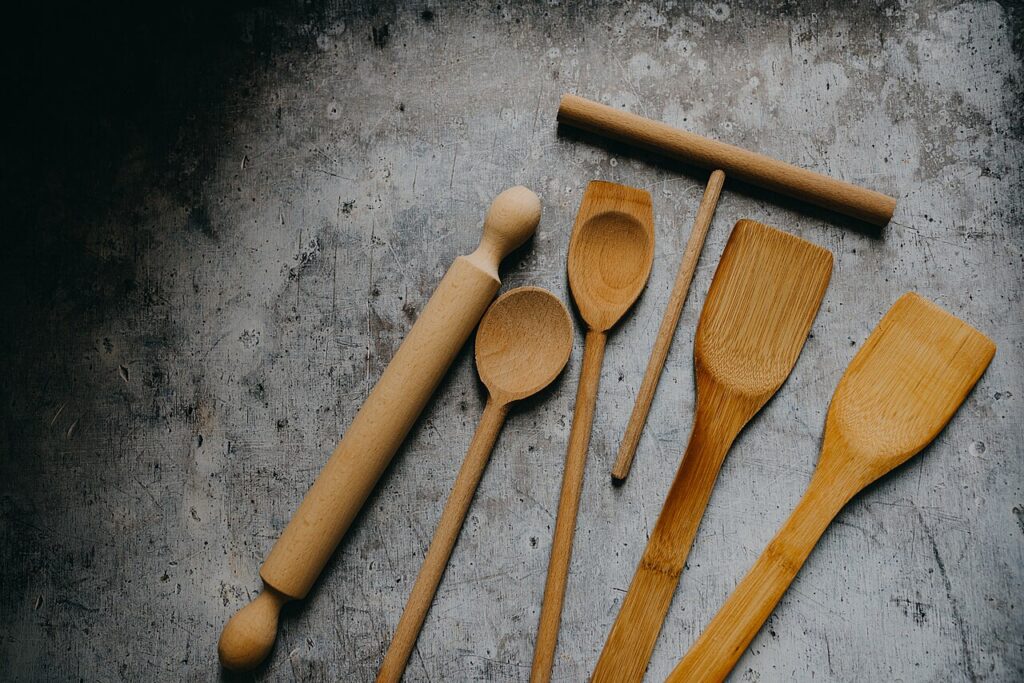

A useful kitchen gadget earns its place between uses as well as during them. A tool that saves a small amount of prep time but is awkward to clean or store may not simplify much. Begin with a task you do often and compare the full routine, from taking the tool out to putting it away.
Notice repeated tasks, not aspirational recipes
For a week, note the steps that slow down ordinary meals: measuring, chopping, draining, opening containers, or organizing small ingredients. Choose a tool for a task that already happens rather than for a cooking habit you hope a purchase will create.
Check what your existing tools can do first. A basic bowl, knife, spoon, or container may already solve the problem. A specialized tool makes more sense when its shape or mechanism offers a clear benefit for your own routine.
Storage and cleaning are part of the design
Measure drawer depth, shelf height, and any counter space the item will occupy. A product photo rarely shows how an awkward handle or fixed attachment fits with the rest of your kitchen. Look for dimensions of the assembled tool and stored configuration.
Read the cleaning instructions before buying. Check which pieces separate, what requires hand washing, and whether the design has tight areas that will be difficult for you to reach. Do not assume a material name means every part is dishwasher safe.
Choose controls and handles you can use confidently
Consider grip shape, required force, stability, and how food is held during use. Product dimensions and instructions can help narrow the choices, but comfort and ease of use remain personal. A return policy is useful when a handle or mechanism is difficult to judge from a picture.
For sharp or powered tools, read the safety instructions and included guards. A convenience feature should not encourage use outside the manufacturer’s directions. Keep appropriate storage and household access in mind.
Compare a manual option with a powered one
A manual tool can be simpler to store and use for a small task. A powered appliance may suit a repeated larger job, but it adds parts, a cord or battery, and possible noise. Check the actual capacity rather than assuming a larger exterior means more usable space.
Consider whether replacement parts, cleaning tools, or compatible containers are available. An accessory that depends on a particular attachment deserves a careful look at that attachment’s fit and support.
A sensible starting list
Potential categories include measuring tools, a suitable strainer, storage organizers, and utensils matched to your cookware. These are ideas to evaluate, not tested product recommendations. Choose according to the food you prepare and the tools you can use safely.
Compare the entire task
Imagine preparing one ordinary meal with the proposed tool. Count taking it from storage, assembling it if needed, using it, washing it as directed, drying it, and putting it away. A tool that simplifies the active step can still be inconvenient overall when it has several small parts or no practical drying space.
The advantage of a specialized tool is a shape or mechanism suited to a repeated job. The limitation is the space and care it adds between uses. Start with one recurring inconvenience, confirm the permitted foods and cleaning process in the manual, and avoid buying a collection around hypothetical recipes.
Sources
Based on the manufacturer and primary-source references below, checked November 12, 2026.
Continue with our smarter shopping field guide and explore more home kitchen guides. Read our editorial policy for sourcing and corrections.