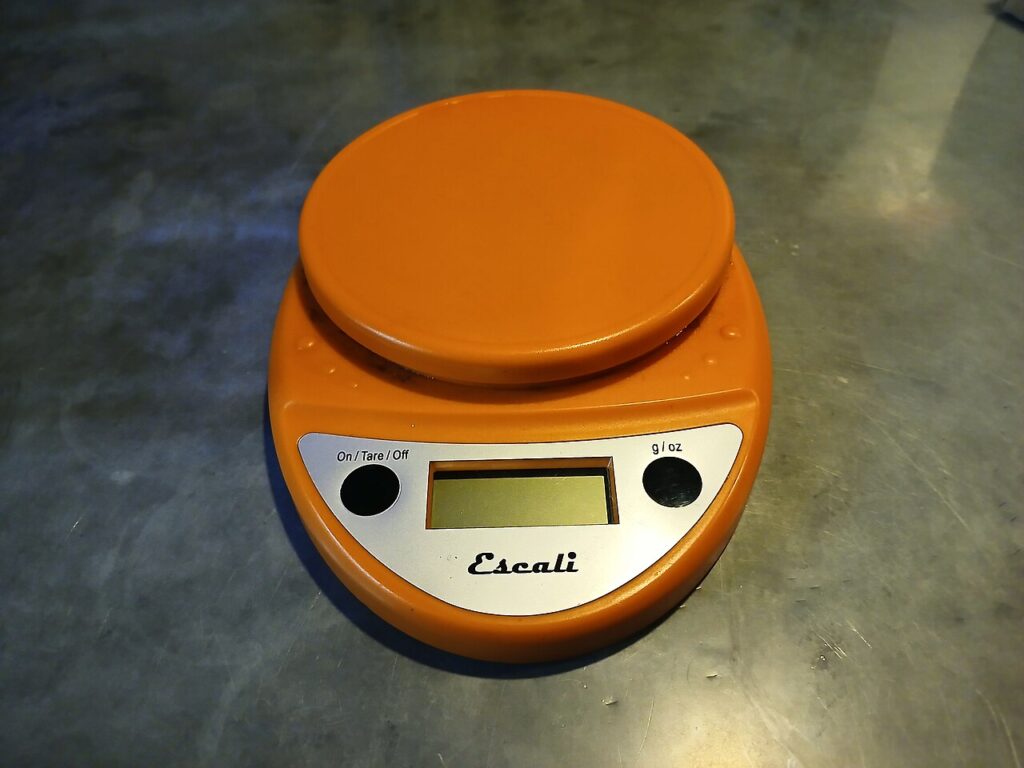

A kitchen scale is most useful when it fits the way you measure, the bowls you use, and the space where you cook. A large maximum capacity is only one specification. Readability, tare behavior, minimum increments, stability, and cleaning can matter more during an ordinary recipe. Put your usual mixing bowl on the counter before making a shortlist.
Match the scale to the quantities
Think about your smallest routine measurement and the heaviest bowl-plus-ingredients combination. Compare the exact scale’s capacity and displayed increments. A scale intended for large batches should not automatically be assumed suitable for very small doses, and a fine increment on the display is not independent proof of measurement accuracy.
If you need precise small quantities, look for evidence and specifications appropriate to that use. Ordinary cooking and specialized measurement should not be treated as identical purchasing requirements.
Check whether you can read it with a bowl
A wide plate or mixing bowl can obscure a display positioned directly beneath it. Compare the platform dimensions, display position, and any documented pull-out or remote display feature. Include the countertop angle and available light in your decision.
Large, clear digits and straightforward unit controls are useful when your hands are busy. Check which measurement units are supported and how they are selected. A unit-change button on the bottom may be less convenient than one you can reach without moving the bowl.
Understand tare and timing behavior
Tare lets you account for a container before measuring ingredients, as described in manufacturer instructions such as OXO’s scale manual. Check the exact model’s process rather than assuming every scale behaves identically. Also read how capacity is counted when a heavy container is already on the platform.
Look at auto-off behavior. A scale that switches off during your normal pause can interrupt a recipe, while a long display period may use more battery. Choose controls and timing that suit your pace rather than treating extra modes as inherently valuable.
Read cleaning instructions before purchase
Consider how the scale handles flour, spills, and storage. A smooth platform can be convenient to wipe, but do not assume the whole appliance can be immersed or placed in a dishwasher. Follow the exact manual for removable parts, cleaning materials, and drying.
Check the power source and access to replacement batteries or charging. Decide where the scale will live between uses. A thin profile may fit a drawer well, provided the storage position does not leave weight pressing on the platform or controls contrary to the instructions.
Build a short cooking-focused comparison
Compare three ordinary tasks: weighing ingredients in your largest bowl, adding a second ingredient after tare, and cleaning up afterward. A well-documented scale that handles these tasks clearly can be more useful than one with numerous conversion modes you rarely use.
Keep the manual and seller return terms.
Sources
Based on the manufacturer and primary-source references below, checked November 12, 2026.
Continue with our smarter shopping field guide and explore more home kitchen guides. Read our editorial policy for sourcing and corrections.