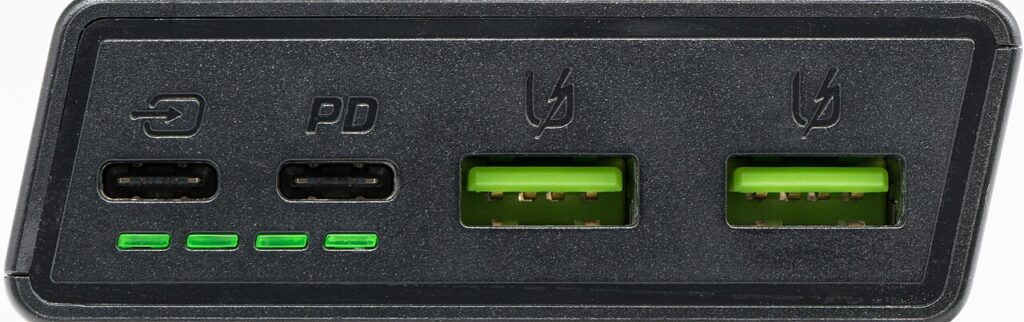

A power bank for a flight has two jobs: meet the transport rules for your journey and charge the devices you plan to carry. Capacity alone does not settle either question. Start with the battery’s readable watt-hour marking, your airline’s current policy, and the charging requirements of your phone, tablet, or laptop. Keep those three records together before purchasing.
Check the current transport rules first
The FAA treats power banks as spare lithium batteries and requires them in carry-on baggage. Its guidance also discusses capacity limits, airline approval for certain larger batteries, protection from damage and short circuits, and stricter carrier rules. Check the current FAA page and your actual airline before departure, including any international connections.
Do not buy based on an unqualified airline-approved label. Rules can vary by carrier and route. If a cabin bag is checked at the gate, the power bank needs to stay with you as the applicable rules require. Choose a packing arrangement that makes it accessible without emptying your whole suitcase.
Read watt-hours and charging output separately
The battery’s watt-hour rating addresses stored energy. Its USB output specification addresses what it can supply to a connected device. A capacity headline in milliamp-hours does not by itself establish laptop charging support. Read the manufacturer’s marked watt-hour rating and the supported output profiles.
For a laptop, confirm that the pack, cable, and laptop agree on the needed charging method. For a phone, decide whether you need wired charging, wireless charging, or simply a convenient cable you will actually carry. Avoid estimating a guaranteed number of full charges without suitable model-specific evidence.
Plan the cables and recharging routine
A built-in cable can reduce loose items, but inspect its length, connector type, and replacement implications. Separate cables are easier to swap when you change devices. Either arrangement should fit your bag without placing constant tension on a connector.
Consider how the power bank itself charges before your return journey. Check the required input cable and charger, not just the output ports. A large pack that is awkward to recharge during a short hotel stop may be less useful than a smaller one that fits your actual schedule.
Choose a practical carrying shape
Compare weight and dimensions with the space available in your personal item. A flat pack may suit a tablet sleeve; a thicker one may fit an accessory pouch better. Leave the battery protected and accessible rather than wedging it next to loose keys or other metal objects.
Look for clear manufacturer support and recall information. Follow the published handling and storage instructions. A damaged or recalled battery is not a travel workaround: consult the manufacturer and carrier rather than attempting to hide or improvise around the problem.
Make the final decision with documents
Save the product model, capacity marking, output specification, and your airline’s policy link. Recheck the rules shortly before travel. This preparation also helps distinguish the battery you own from a similar-looking version in a marketplace listing.
The useful outcome is a compatible, clearly documented battery and a packing plan that fits the actual journey.
Sources
Based on the manufacturer and primary-source references below, checked November 12, 2026.
Continue with our smarter shopping field guide and explore more tech guides. Read our editorial policy for sourcing and corrections.